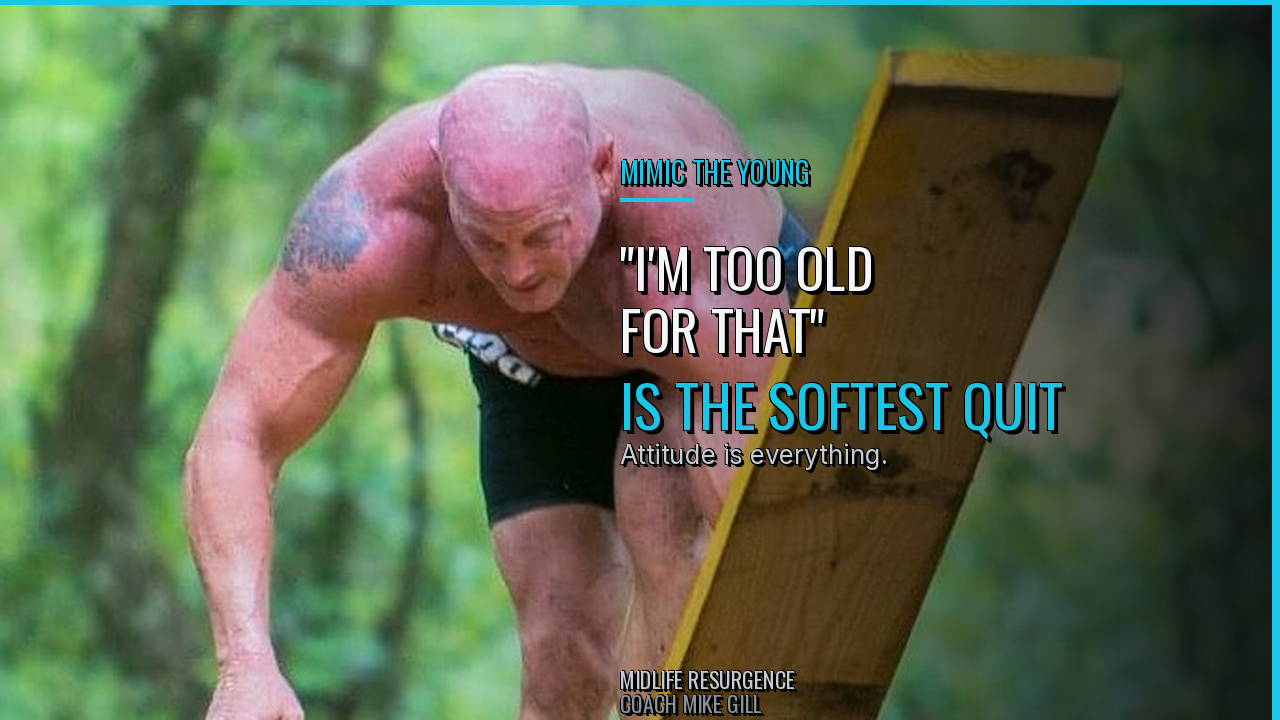
“I’m Too Old for That” Is the Softest Quit
Not a medical condition. A quiet exit you rehearse until it feels like wisdom.
Kids don’t need a manifesto to stay in the game. Midlife men do — because the culture sells decline as sophistication.
“I’m too old for that” sounds responsible. It feels mature. It’s usually neither. It’s the softest quit: no fight, no deadline, no rematch. Just a smaller life with better excuses.
Mimic the Young isn’t cosplay. It’s behavioral youthfulness as the longevity lever — train hard, learn new skills, stay socially dense, refuse that line.
The quit in slow motion
Permission to skip the hard session. Permission to stop learning. Permission to shrink the calendar until the only circle left is the couch and the group chat.
Younger adults still do the opposite by default. They move. They pick up skills. They stay in rooms with other people. Those aren’t decorations. They’re the levers.
The soft quit rarely announces itself. It shows up as one skipped workout that becomes a week, one closed door that becomes a smaller identity, one quiet “maybe later” that becomes never. You don’t lose the fight. You stop showing up for it.
What I still do that my 25-year-olds dodge
Hard intervals I can recover from. A skill block every month that makes me clumsy on purpose. Partners who will call if I ghost.
I don’t win every set. I stay in the room.
That’s the whole point. Behavioral youthfulness isn’t about beating twenty-somethings at their game. It’s about keeping the same levers they still pull without thinking: effort, novelty, and people who expect you to show up.
Thirty-day language lock
Drop “I’m too old for that.” Replace it with “not yet” or “how would a younger me attack this.”
Then back it with one hard session, one beginner skill, one recurring human touchpoint. Language without action is just a nicer excuse. Action without the language still leaks through the old story. Lock both.
- Move: one hard session you can recover from and repeat
- Learn: one beginner skill that makes you clumsy on purpose
- Social: one recurring touchpoint with someone who will call if you ghost
- Language: thirty days without “I’m too old for that”
Kids run for fun. Adults invent reasons not to. We’re not buying the soft quit.
Mimic the Young. Attitude is everything. Act it.
Yours in health
Coach Mike Gill,
The Midlife Resurgence: A Modern Genetix show
I am not a doctor. This is not medical advice. Research cited here is summarized for education, not diagnosis or treatment. Talk to your physician before you start a fitness or nutrition program.