Build the Base
Patterns you can name. A week you can defend.
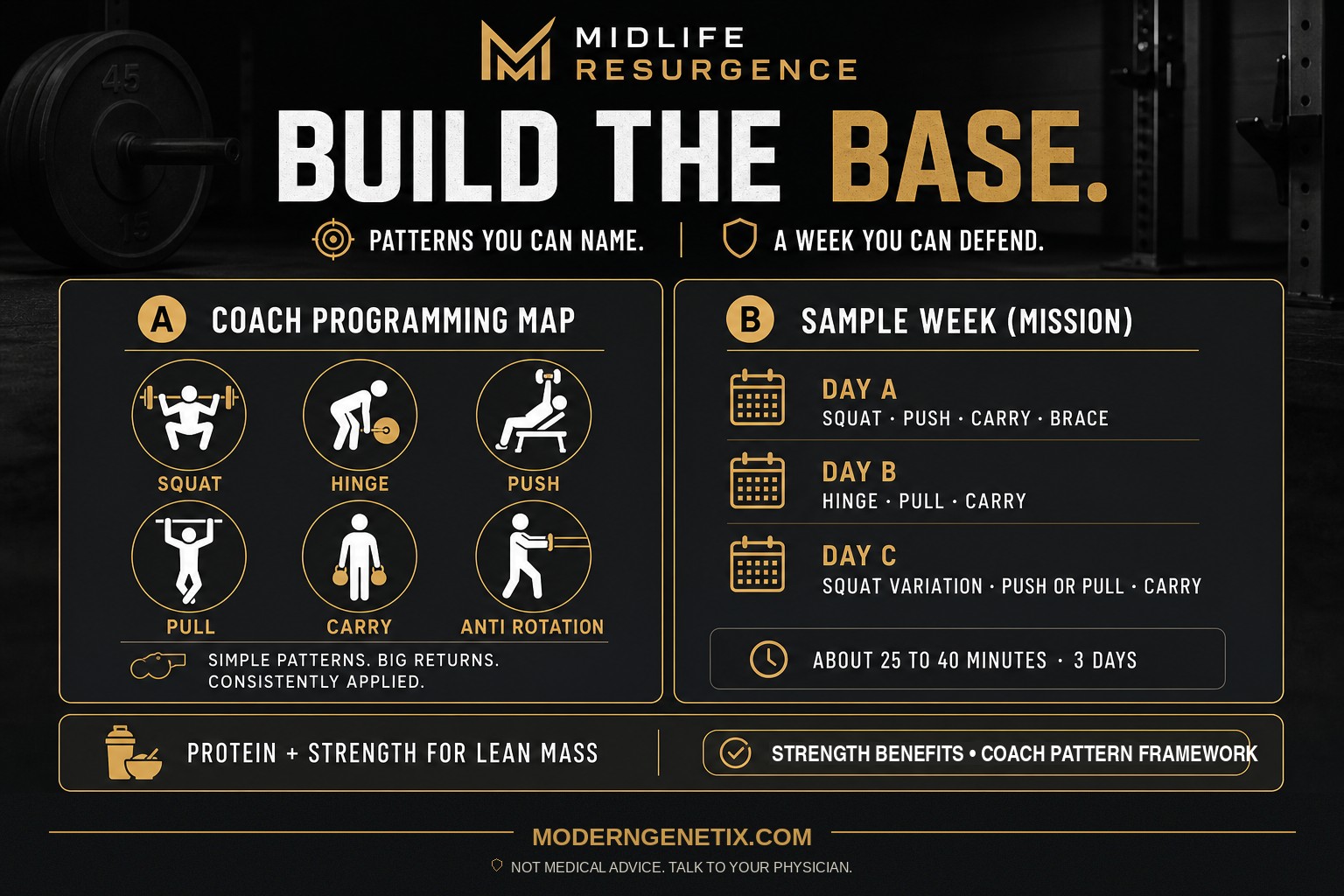
If you only remember one coaching map from this series, make it this one.
You do not need forty isolation exercises and a color coded spreadsheet. You need a base you can carry through a real life: squat, hinge, push, pull, carry, and a simple anti rotation brace so your trunk actually helps you lift and live.
That list is a programming map. It is how I organize weeks for mid career adults who still want to be useful on the job site, on the trail, and with grandkids who do not care about your “optimal” split.
Patterns are a coach map
Evidence reviews are clear that resistance training improves strength, hypertrophy, power, and function compared with no exercise. Many modalities work when effort and consistency are real. Major muscle groups at least twice a week remains a stickable floor.
Squat, hinge, push, pull, and carry come from long standing coach taxonomies, including the Dan John lineage of fundamental human movements. Anti rotation work (think Pallof style bracing) is common core stability practice. This is a programming map for balanced weeks. It is not a mandated exercise list and not a claim that these six names are the only valid path.
I use the map because adults remember it. “Did I squat, hinge, push, pull, and carry this week?” beats “Did I hit seventeen Instagram movements?”
What each pattern buys you on the floor
Squat
Sit down and stand up with load or bodyweight. Goblet squat, box squat, or a machine that lets you own the range. Knees and hips share the work.
Hinge
Hip driven power and posterior strength. Romanian deadlift, kettlebell hinge, hip thrust variations you can load safely. The hinge teaches you to pick things up without turning every grocery run into a back story.
Push
Press away from you. Push up, dumbbell press, landmine press, or a machine press when joints need a friend.
Pull
Row and pull toward you. Cable row, chest supported row, band pull, or a pull up progression. Midlife posture and shoulder health love honest pulling.
Carry
Walk with load. Farmer carry, suitcase carry, or a front loaded carry for a short distance. Carries teach grip, trunk, and “can I still move under fatigue.”
Anti rotation
Brace so your ribs and pelvis stay honest while the world tries to twist you. Pallof press style holds or short marches with a light press out. This is trunk work that transfers to real lifting.
You can swap tools. Dumbbells, kettlebells, cables, machines, bodyweight. The pattern is the point.
Sample week card
Exact minutes and exercise picks below are coach design for Midlife Training Base.
Week card: 3 days, about 25 to 40 minutes.
Day A
- Goblet squat 3 sets
- Dumbbell bench or push up 3 sets
- Farmer carry 3 short trips
- Pallof style brace 2 to 3 holds each side
Day B
- Romanian deadlift or kettlebell hinge 3 sets
- Chest supported row or cable row 3 sets
- Suitcase carry 3 short trips each side
- Optional light anti rotation if recovery feels good
Day C
- Split squat or step up 3 sets each side
- Overhead or landmine press if shoulders allow, else push up variation 3 sets
- Pull variation you underdid on Day B 3 sets
- Short carry finisher
Leave reps in the bag. Quality over grind. If a joint is loud, shrink range or swap the tool and keep the pattern.
Meals that carry the training
Training asks for food that shows up.
Protein plus strength work is the pairing people talk about when the goal is protecting lean mass during weight change. Nutrient dense whole foods beat a diet made of vibes and drive thru hope. Exact macros are personal and medical context matters, so I will not invent a universal number set here.
Practical coach plate for most adults I see:
- A protein anchor at each meal (eggs, fish, poultry, lean beef, Greek yogurt, cottage cheese, beans if they sit well)
- Fruit or vegetables you will actually eat
- Carbs around training when you need fuel for the session
- Water through the day instead of waiting until you feel wrecked
- Simple batch prep so Tuesday does not become a negotiation
You do not need a perfect kitchen. You need a plate that supports the week you just earned on the floor.
Soft next step
This is the Midlife Training Base in one page: patterns you can name, a week you can defend, food that supports lean mass and recovery.
If you want the map coached to your joints, schedule, and equipment, that is the hire. Modern Genetix products, when they sit on your shelf path, are brand placement beside the work: training day support, recovery tools, everyday nutrition helpers. They do not diagnose, treat, or replace medical care. They do not replace the squat or the plate.
Build the base. Keep the base. Let the year compound.
Yours in health
Coach Mike Gill,
The Midlife Resurgence: A Modern Genetix show
I am not a doctor. This is not medical advice. Talk to your physician before you start a fitness or nutrition program.